When specifying foundry coke, buyers often ask for a single number: "I need 7,400." But calorific value means nothing without fixed carbon (FC), ash content, and the reporting basis. Here is how these variables actually relate — and where real foundry coke specs land.
The Core Relationship
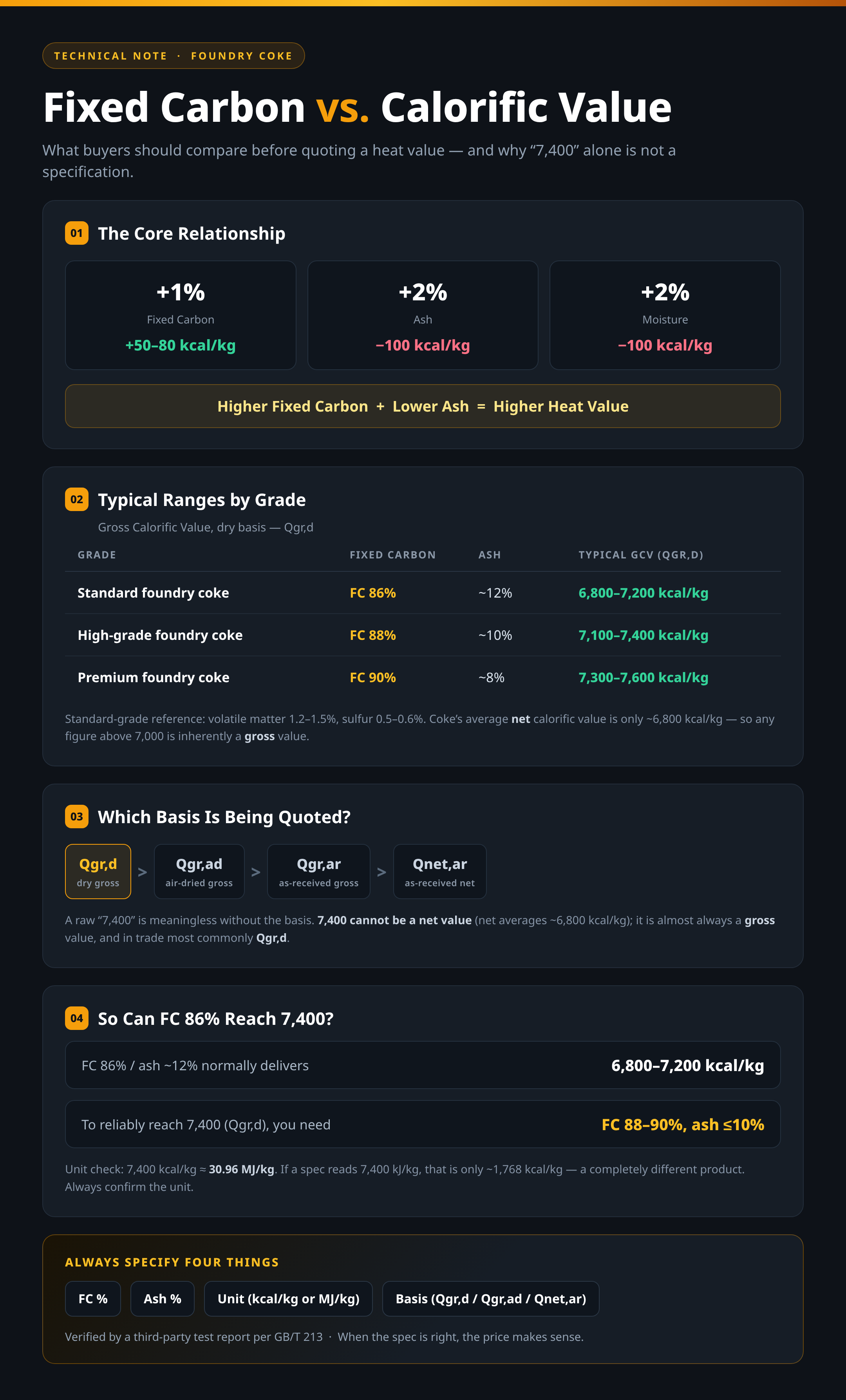
Calorific value of foundry coke is driven mainly by fixed carbon and ash:
Every +1% fixed carbon ≈ +50–80 kcal/kg in calorific value
Every +2% ash ≈ −100 kcal/kg
Every +2% moisture ≈ −100 kcal/kg (moisture matters on an as-received basis)
In short: higher FC and lower ash = higher heat value.
Typical Ranges by Grade (Gross Calorific Value, Dry Basis — Qgr,d) ,for your reference
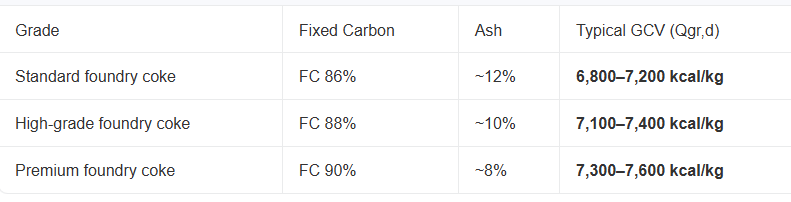
Typical accompanying specs: volatile matter 1.2–1.5%, sulfur 0.5–0.6% (standard grade). For reference, coke's average net calorific value is only ~6,800 kcal/kg, so any figure above 7,000 is inherently a gross value.
Which Basis Is Being Quoted?
A raw "7,400" is meaningless without the basis. The values rank as follows for the same material:
Qgr,d (dry gross) > Qgr,ad (air-dried gross) > Qgr,ar (as-received gross) > Qnet,ar (as-received net)
Consequently:
7,400 cannot be a net value — net averages ~6,800 kcal/kg
It is almost always a gross value, and in trade most commonly expressed as gross calorific value on a dry basis (Qgr,d)
For FC 86%, a target of 7,400 kcal/kg (Qgr,d) is above the normal range — reaching it reliably requires FC 88–90% and ash ≤10%
FAQ
Q: My supplier quotes FC 86% — why can't it hit 7,400?
A: FC 86% with ~12% ash normally delivers 6,800–7,200 kcal/kg (Qgr,d). To reach 7,400, you need higher FC and lower ash — i.e. a premium grade — which carries a higher price.
Q: Is 7,400 kcal/kg or kJ/kg?
A: Units matter. 7,400 kcal/kg ≈ 30.96 MJ/kg (30,960 kJ/kg). If a spec reads 7,400 kJ/kg, that is only ~1,768 kcal/kg — a completely different product. Always confirm the unit.
Q: Which standard applies?
A: Calorific value should be verified by a third-party test report per GB/T 213, with fixed carbon, ash, volatile matter and total moisture reported alongside.
Takeaway for Buyers
Never specify calorific value alone. Always state FC%, ash%, unit (kcal/kg or MJ/kg), and basis (Qgr,d / Qgr,ad / Qnet,ar). Only then is a heat-value target technically meaningful — and only then can a supplier guarantee it.
When the spec is right, the price makes sense. Specify the basis first, then talk numbers.
#FoundryCoke #MetallurgicalCoke #CarbonRaiser #FixedCarbon #CalorificValue #Foundry #SteelCasting #CokeSupplier #CarbonAdditive #FuelSpecs