Semi-Coke vs Metallurgical Coke: Key Differences, Properties and Industrial Applications
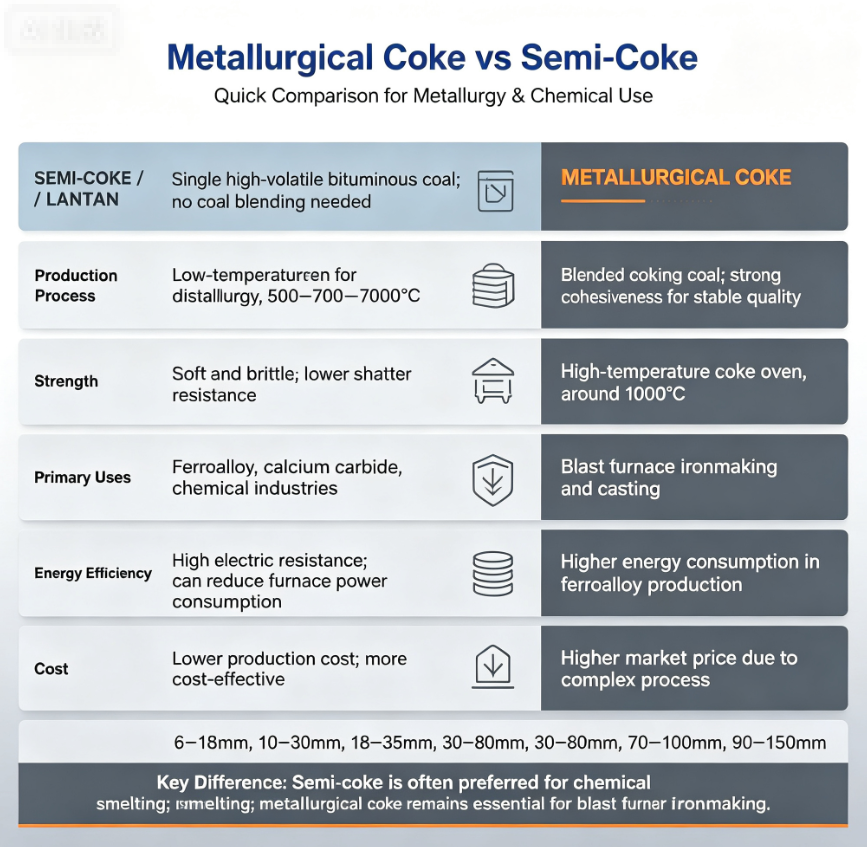
Semi-Coke vs Metallurgical Coke is an important comparison for companies involved in ferroalloy production, calcium carbide manufacturing, chemical processing and ironmaking.
Although both materials are carbon-rich products used as fuels, carbon sources or reducing agents, they are produced under different conditions and serve different industrial purposes.
Understanding the differences in production temperature, fixed carbon, reactivity, electrical resistivity, mechanical strength, particle size and application requirements can help manufacturers select the appropriate carbon material for their process.
What Is Semi-Coke?
Semi-coke, also known as Lan Tan or Blue Charcoal, is a carbonaceous solid produced through the low-temperature carbonization or pyrolysis of coal.
Depending on the raw coal and production technology, low-temperature carbonization is commonly carried out in the approximate range of 500–800°C.
Compared with conventional metallurgical coke, semi-coke generally retains different levels of volatile matter and has a different pore structure and reactivity.
Typical characteristics may include:
Actual specifications vary according to the coal source, production process and customer requirements.
What Is Metallurgical Coke?
Metallurgical coke is a carbonaceous material produced by carbonizing selected coking-coal blends at high temperature.
Unlike semi-coke, metallurgical coke is specifically engineered for demanding metallurgical environments, particularly blast furnace ironmaking.
Coke performs several important functions in a blast furnace. It provides carbon, contributes to the generation of reducing gases, supports the burden and helps maintain permeability within the furnace.
Because of these functions, coke quality cannot be evaluated only by fixed carbon content.
Important metallurgical coke indicators include:
CRI and CSR are widely used to characterize coke reactivity and post-reaction strength.
The exact specification should always be determined according to the customer's furnace design and production process rather than relying on a generic comparison.
Applications of Semi-Coke
1. Ferroalloy Production
Semi-coke is widely used as a carbonaceous reducing material in electric-furnace ferroalloy production.
Applications can include:
Ferrosilicon
Silicon manganese
Ferrochrome
Other ferroalloys
Its electrical and chemical characteristics can be relevant to submerged arc furnace operation.
2. Calcium Carbide Production
Semi-coke can also be used as a carbon source and reducing material in calcium carbide production.
For this application, customers commonly pay close attention to:
Fixed Carbon + Ash + Sulfur + Phosphorus + Particle Size + Reactivity
3. Chemical Industry
Depending on the specification, semi-coke can be used in various chemical and metallurgical processes where a controlled carbon source or reducing agent is required.
Applications of Metallurgical Coke
Metallurgical coke is particularly important in blast furnace ironmaking.
Inside the blast furnace, coke must withstand mechanical loading and high-temperature reaction conditions while maintaining an appropriate burden structure and permeability.
For this reason, metallurgical coke quality is often discussed in terms of CRI and CSR, in addition to conventional chemical specifications.
Can Semi-Coke Replace Metallurgical Coke?
This is one of the most common questions from industrial buyers.
The answer depends on the specific process.
Semi-coke and metallurgical coke should not automatically be considered direct substitutes.
For an electric furnace producing ferroalloys, properties such as electrical resistivity, reactivity, fixed carbon, ash and sulfur may be particularly important.
For blast furnace ironmaking, coke must meet demanding mechanical, thermal and reaction-performance requirements.
Therefore, substitution should be evaluated through:
Process requirements → Furnace conditions → Material specification → Trial performance → Cost analysis
rather than simply comparing the price per metric ton.
What Should You Ask a Carbon Material Supplier?
Before purchasing Semi-Coke or Metallurgical Coke, industrial buyers should request a complete technical specification.
Chemical Properties
Fixed Carbon (FC)
Ash
Volatile Matter (VM)
Sulfur (S)
Phosphorus (P)
Moisture
Physical Properties
Particle size
Bulk density
Porosity
Mechanical strength
Process-Related Properties
A supplier capable of providing consistent specifications and reliable quality documentation can help reduce variability in downstream production.
Conclusion
The difference between Semi-Coke and Metallurgical Coke is not simply the production temperature.
The two materials have different structure, reactivity, electrical properties, mechanical behavior and industrial applications.
In general:
Semi-Coke / Lan Tan → ferroalloys, calcium carbide and selected chemical/metallurgical processes.
Metallurgical Coke → blast furnace ironmaking and applications requiring high mechanical and thermal performance.
The correct material should therefore be selected according to the actual furnace and process requirements.
If your company is sourcing Semi-Coke, Lan Tan, Blue Charcoal or Metallurgical Coke, a technical specification-based evaluation is the best starting point.
Contact our team to discuss your required carbon content, ash, sulfur, phosphorus, particle size and application requirements.